Introduction
You might hear people use Artificial Intelligence (AI) and Machine Learning (ML) interchangeably, especially when discussing big data, predictive analytics, and other digital transformation topics. The confusion is understandable as artificial intelligence and machine learning are closely related. However, these trending technologies differ in several ways, including scope, applications, and more.
AI and ML help businesses
analyze data, improve decision making, and generate insights. AI is broader,
while ML focuses on learning from data. Their connection shapes modern
organizational strategies and predictions. We will break down AI vs ML and
explore how these two innovative concepts are related and what makes them
different from each other.
What is Artificial Intelligence?
Artificial Intelligence is the broad science of making machines think and act like humans. Think of AI as teaching a computer to mimic human intelligence, which includes the ability to reason, learn, perceive, and solve problems
Imagine a robot that can play chess, recognize your face in photos, answer your questions, and drive a car. All these abilities fall under the umbrella of AI. The robot is not just following a simple set of instructions. It is processing information, understanding context, and making decisions, much like a human would.
AI can be as simple as a spam filter in your email that learns which messages are junk, or as complex as self-driving cars that navigate busy streets. The key idea is that AI systems are designed to perform tasks that normally require human intelligence.
What is Machine Learning?
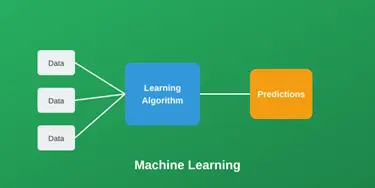
Machine Learning is a specific subset of AI. It is the method by which computers learn from data without being explicitly programmed for every task. Instead of writing thousands of rules, we feed the machine examples, and it figures out patterns on its own.
Think about how Netflix recommends movies to you. Netflix does not have a person manually selecting films for each of its millions of users. Instead, it uses Machine Learning. The system looks at what you have watched, what you have liked, and what similar users enjoy. Then it learns your preferences and suggests movies you might like. The more you watch, the smarter it gets.
Another everyday example is your email's spam filter. It learns from the emails you mark as spam and the ones you keep. Over time, it gets better at recognizing junk mail without you having to set specific rules.
How AI and ML are connected.
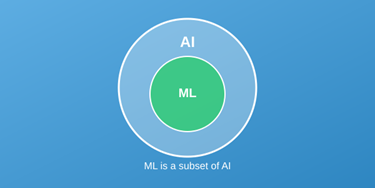
Think of AI as a big circle and ML as a smaller circle inside it. Machine Learning is one of the ways we achieve Artificial Intelligence. In other words, ML is a tool or technique used to create AI systems.
Imagine AI is like cooking in general. It is the broad goal of making food. Machine Learning is like a specific cooking technique, such as baking. You cannot say baking is the same as cooking, but baking is definitely one way to cook. Similarly, ML is one way, and currently the most popular way, to achieve AI.
Every ML application is an AI application, but not every AI application uses ML. Some AI systems use rule based programming or expert systems that do not involve learning from data. However, in today's world, the most powerful AI applications, like virtual assistants, recommendation engines, and image recognition, rely heavily on Machine Learning.
AI and ML application in daily life
Both AI and ML are already woven into our everyday lives, often without us even realizing it. Here are some examples;
Virtual Assistants (AI and ML)
Siri, Alexa, and Google Assistant use AI to understand your voice commands and ML to get better at recognizing your speech patterns and preferences over time.
Social Media Feeds (ML)
Instagram, Facebook, and TikTok use Machine Learning to analyze your behavior, including what you like, share, and how long you watch, to show you content that keeps you engaged.
Navigation Apps (AI and ML)
Google Maps and Waze use AI to calculate routes and ML to predict traffic patterns based on historical data and real time information from other drivers.
Online Shopping (ML)
Amazon's "Customers who bought this also bought" feature is powered by ML algorithms that learn from millions of purchase patterns to make personalized recommendations.
Smart Home Devices (AI)
Smart thermostats like Nest learn your schedule and temperature preferences, automatically adjusting settings to keep you comfortable while saving energy.
Banking and Fraud Detection (ML)
Your bank uses Machine Learning to detect unusual spending patterns and flag potentially fraudulent transactions before you even notice something is wrong.
Conclusion
While AI and ML are often used interchangeably, understanding their differences helps you appreciate how these technologies work together. AI is the dream of creating intelligent machines, and ML is one of the most powerful tools we have to make that dream a reality. As both technologies continue to evolve, they will become even more integrated into our daily lives, making our interactions with technology smarter, more personalized, and more intuitive.
Artificial Intelligence (AI) vs Machine Learning (ML)